
A Diner's Guide to Mars
To the Michelin stars by hard ways

NASA’s first brush with malnutrition came during the Apollo 15 mission in 1973. Over the course of three strenuous moon walks, astronauts David Scott and James Irwin grew dehydrated and started exhibiting an irregular heartbeat. By the time the two returned to the orbiting command module, they were clearly exhausted and were struggling to complete basic tasks. They had also inadvertently left a number of items behind on the moon.
Analysis after the mission concluded that dehydration and lack of sleep had exacerbated an electrolyte deficiency that had probably set in during the final days of training before launch. NASA estimated that the lunar astronauts had lost about 20% of their body potassium (later work also implicated magnesium). Irwin experienced the more severe heart symptoms of the two, and it’s possible that his lunar exertion did him lasting harm; he died of a heart attack in 1991.
On the next moon mission, NASA overcompensated, fortifying the astronauts’ food with lavish amounts of potassium and pushing them to imbibe an orange drink laced with the element. An accidental open mic moment captured astronauts John Young and Charlie Duke discussing the effects of this diet while relaxing after a moon walk.
Young: I have the farts, again. I got them again, Charlie. I don’t know what the hell gives them to me. Certainly not...I think it’s acid stomach. I really do.
Duke: It probably is.
Young: (Laughing) I mean, I haven’t eaten this much citrus fruit in 20 years! And I’ll tell you one thing, in another 12 fucking days, I ain’t never eating any more. And if they offer to sup(plement) me potassium with my breakfast, I’m going to throw up! (Pause) I like an occasional orange. Really do. (Laughs) But I’ll be durned if I’m going to be buried in oranges.
NASA dialed down the potassium on the the final mission. But the heartbeat episode was just one of many dietary lessons the agency learned the hard way on Apollo. The moon landings were the first time NASA had to integrate meal planning into a large, complex mission, and there was a lot to get wrong. Perhaps the most important lesson was that Apollo food rations, a system of dehydrated pouches and rubbery cubes, were borderline inedible. A man who described himself as a “human garbage can” volunteered in 1969 to eat the Apollo diet as a test and declared that after four days, all the joy had gone out of eating.
He had regrets at the first meal, breakfast. The sausage patties seemed like flavored ground rubber and left a long lasting and sickening aftertaste. After one day, the tester’s appetite was much less than usual and by the third day mealtimes were unwelcome and eating was unenjoyable work. Space food similar to normal every day food was good but food designed for space was very bad. Chocolate and peanuts, which could have been left alone, were ground up and converted into bite-size cubes that stuck to the teeth.
To make matters worse, the water astronauts used to reconstitute their food contained large amounts of dissolved hydrogen gas, leading to bloating and more space farts. The Apollo crews also struggled with the mechanics and hygiene of zero gravity dining. In his memoir, Irwin describes a typical Apollo mealtime in some detail:
We had Velcro all over the spacecraft and on the meal packages, so to keep track of things we’d stick our dinner on the wall, course by course. If you nudged the meat course accidentally, it would take off, and you would have to float after it or get the help of a buddy downfield.
The soups were probably the most popular food that we had on board. We also had a variety of meats in aluminum foil—ham, frankfurters, turkey, and steak, in flat slices except for the frankfurters. The meats had different consistencies, but all had the same taste. When we cut open the end of the aluminum package and slid the meat out, the gravy or grease would slide out in blobs and float around the spacecraft [...] when we had finished eating, we had food all over us like a bunch of two year olds.
The food packages were very compressed when we started out, but after you finish eating the food you end up with packages that are twice as big, and you have the problem of stowing them away.
This involved cutting open another bag, breaking out our supply of yellow bacteria pills, and putting a few into each bag along with remnants of food. Then we would wind up each bag like a spent tube of toothpaste and shove them into the large plastic bag and pop that into a container. You had to squeeze everything real tight, or the bags would fill up with oxygen and billow out. We didn’t have room for that, and we didn’t have room to grow a crop of bacteria either. Sometimes, with all the bags around in different stages of the cycle, it looked as if the Monday wash was hanging out.
Housekeeping! Nothing but housekeeping!
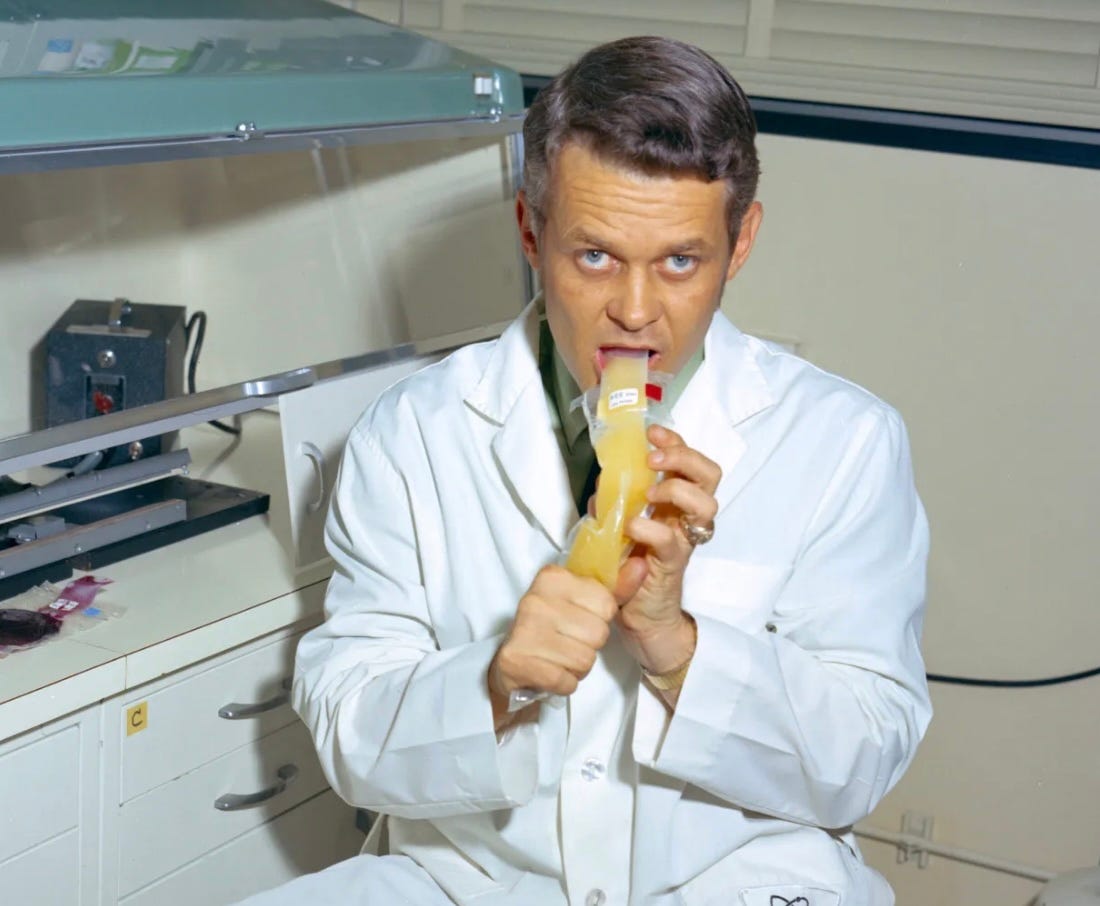
Just like the space toilet, experience with in-flight dining on the moon missions showed that there were limits to human fortitude, even among the astronaut corps. So for the Skylab missions, which would last up to 56 days, NASA made a serious effort to make eating easier and more pleasant. The big lesson was to replace the tubes of featureless goo and freeze-dried powders with pre-cooked wet pack meals that bore at least some resemblance to normal food on Earth.
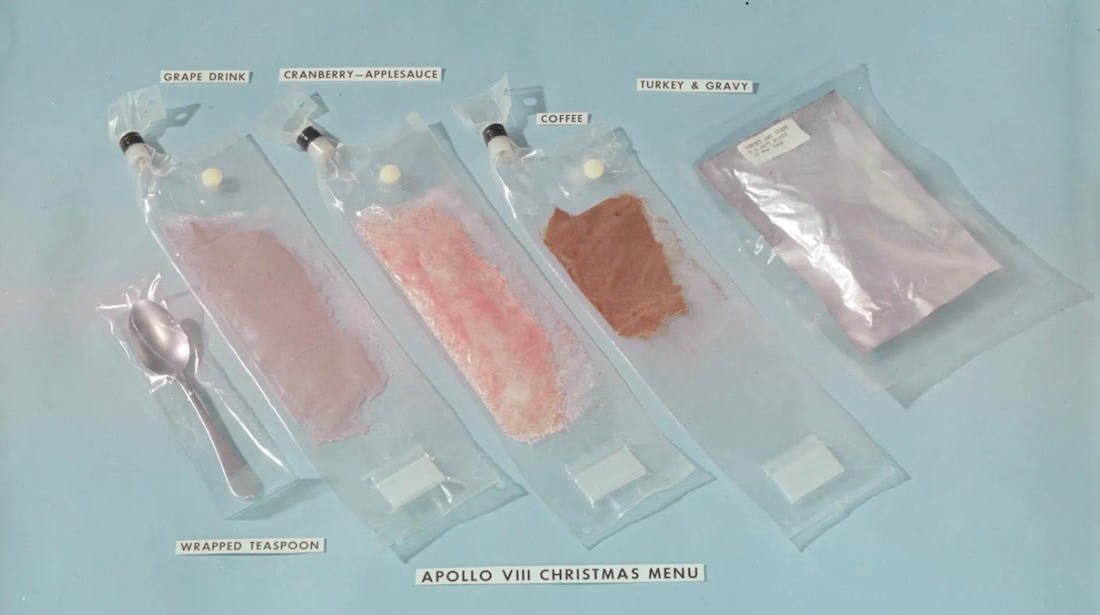
By far the biggest culinary hit on the Apollo missions had been a surprise Christmas dinner sent up on Apollo 8, which included a pouch of turkey and gravy. Unlike every other space meal served up to that time, it contained recognizable chunks of meat and was a sensation with the astronauts. NASA had developed and tested the technology in secret, as a treat for the crew, and it marked a path forward for space dining.
Skylab would prove much better than Apollo on the food front. It was also the only space mission where a crew ate its full allotment of calories. This was due entirely to cajoling from the medical team, who insisted on a strict accounting of food in and food out, with clean pouches at every meal.
Everyone agrees that the food on the International Space Station is tasty. Astronauts get to select their preferred menu on the ground, and like in a middle school lunchroom, there’s a lively orbital barter economy between astronauts of the various space agencies (Russian, European, Japanese, and American) who trade delicacies with one another. (The nuclear-strength Russian mustard is a particular favorite.)
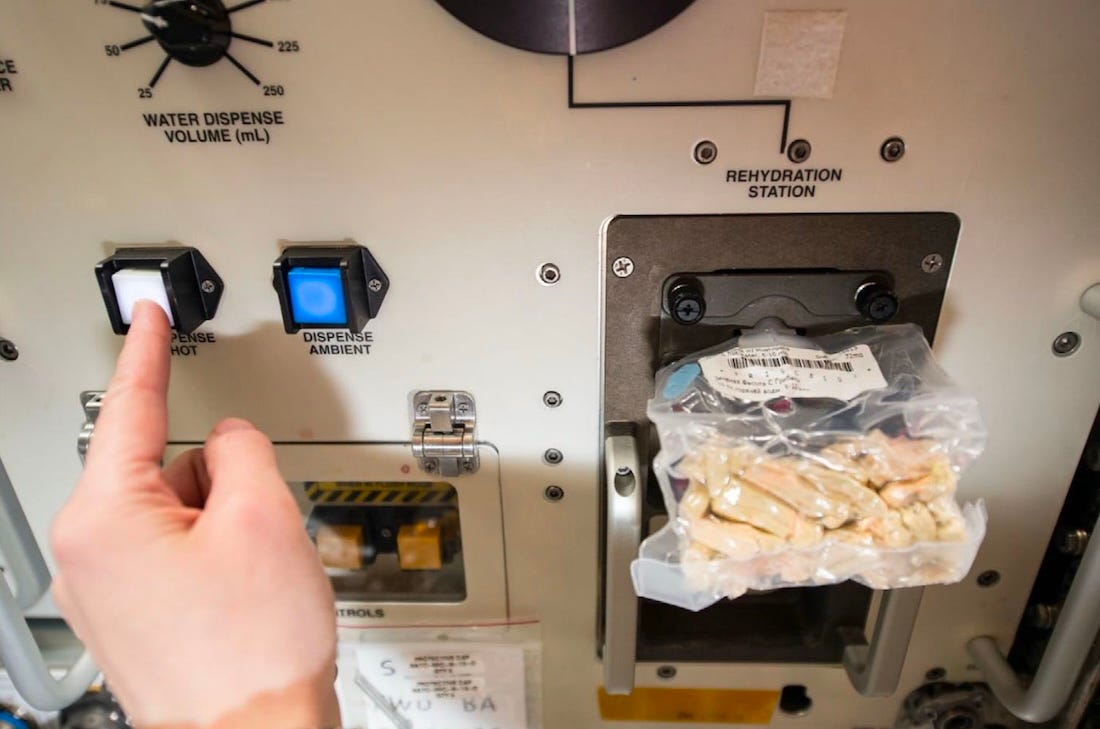
The space station galley has approximately the same cooking facilities as an office breakroom. There is a microwave oven, hot and cold water on tap, and a very small refrigerator. (The coffee maker was removed some time ago after a successful trial run). Officially there is no alcohol allowed on board, but every once in a while NASA spends a few months trying to run down a spike in atmospheric ethanol that is inevitably traced to obscure origins somewhere in the Russian half of the station.
Astronauts on the ISS supplement their diet not only by trading with rival space agencies, but through periodic deliveries of fresh fruits and vegetables from Earth, as well as the occasional bit of salad or tomato from onboard experiments. Coolers needed to fly experiments down to Earth in a controlled temperature arrive on the space station packed with ice cream. And yet crews on the space station still consistently undereat, consuming only about 80% of their space calories on long-duration missions.
There’s no dearth of theories about why this happens. The ISS smells vaguely like a bus station toilet, the ambient noise level is high, there’s a lot of carbon dioxide in the air, and things in general taste different in space. Researchers have known for a while that flavors are altered even aboard commercial airplane flights. Sweet foods in an airline meal will taste less sweet, while umami flavors are enhanced, so passengers order more tomato juice and bloody marys in flight than they would ever consume in the airport lounge. Whatever the cause of the flavor change phenomenon, it seems to extend to space in an exaggerated form.
An ISS-like level of undereating poses a risk on Mars-length missions, where bone and muscle loss are already two of the most significant hazards of long duration exposure to free fall. The crew really can’t afford to lose any weight, and the hours of daily exercise they have to perform in space make the problem worse, by increasing their calorie requirement without adequately boosting their appetite.
So the challenge for Mars-length missions is to develop a food system that is safe, nutritious, and palatable enough to keep the crew well-fed for years, right down to the last meal they eat before returning to Earth.
Breaking the 5 year barrier
To understand why the Mars food problem is hard, consider the fate of a Mars-bound pizza. It begins life in an industrial oven, baked and then portioned into squares that get sealed into an individual foil bag. The bag is briefly heated (or perhaps zapped with radiation) to sterilize the contents, and from there the pizza is labeled, boxed, stowed, and begins its long journey through a logistics support chain that ends in warehouse near a launch facility.
One day, the pizza is placed on top of a rocket and launched into space, a shaky process that means nothing to a pizza but might disrupt a more fragile piece of food. If the slice is part of the meal allotment for a Mars-bound crew, it will spend the rest of its existence at room temperature (say 22˚C) and may have to wait two years or more before it’s eaten. If it’s being sent as part of a cargo shipment meant to be pre-positioned on Mars, it can make the trip over at a colder temperature (with no crew on board, nothing prevents cargo from being sent frozen) but will then have to spend three or more years in ambient conditions there, waiting for someone to come eat it.
Once you account for logistics, delays, and the short duration of launch windows to Mars, you can see how five years or more might elapse from the time a piece of space food is cooked and packaged to when it’s served for dinner.
There are three challenges to achieving such a long shelf life.
The first is avoiding spoilage, and for that we have no shortage of technologies. Foods can be pasteurized, microwaved, freeze-dried, frozen, irradiated, packed with preservatives, pickled, or canned. All of these techniques work well. Soldiers in Vietnam ate C-rations from Korea, Korean war soldiers ate surplus rations from WWII, and today YouTube is full of stunt diners sampling ancient military rations (all the way back to Napoleon!) with no immediate ill-effects, at least on screen.
Nutrition is a bigger hurdle. In addition to base calories and good quality protein, human beings need to consume thirteen dietary vitamins and about a dozen minerals. Some of these nutrients are indestructible, while others, particularly vitamins A, C, E and thiamine (B1), degrade quickly in stored foods.
Vitamins can be supplemented, but the supplements degrade as well. And there are non-essential nutrients, like phytochemical anti-oxidants, that would be good to have in the diet but are hard to store.
The most difficult problem in preserving food is palatability. Over time, all shelf-stable food wants to assume the color and texture of brown applesauce. This process can be slowed down by keeping food cold, but freezing has its own effects on texture, and it is impractical for a Mars mission1. The texture of shelf-stable foods degrades with age, and chemical reactions alter the taste and consistency of stored foods for the worse. This is not due to spoilage, but to interactions between the constituents of the food itself. The chief culprits in the process are the Maillard reaction and lipid oxidation.
Every home chef loves the Maillard reaction. It forms the golden brown crust on bread and gives seared meat its distinctive brown crust and depth of flavor. But in the food storage context, the Maillard reaction is a villain. While we normally associate it with high heat, it can also go forward in room temperature or even refrigerated foods, introducing off flavors and a sense of staleness. Milk products (including powder) are particularly susceptible, especially if they have been fortified with iron. Dried fruit is another frequent casualty. A notable problem with Maillard reactions is that they corrupt proteins, making them less digestible as a whole, while degrading the individual amino acids that constitute them.
Lipid oxidation is just a fancy way of saying that fats get rancid when you expose them to air. The amount of air this takes is tiny, making it a challenge to properly purge foods and exclude all air from packaging.
Both types of reactions go faster at higher temperatures, so the colder we can keep packaged foods, the longer their potential shelf life. But as I’ve written about in the past, bulk refrigeration is impractical on a spacecraft, which is best thought of as a large thermos.
So the global problem remains unsolved. Short of feeding a crew canned beans and ship’s biscuit, there is no known food system that can keep food unspoiled, nutritionally complete, and palatable for the five years necessary to sustain a Mars-bound crew.
What makes the problem especially thorny is the requirement for variety. If we could create a single balanced food (call it Soylent Mars) to meet the necessary nutritional and taste requirements, and feed a crew off of it, it would be one thing. But outside the world of software development, dietary variety seems to be a basic human need, with menu fatigue and concomitant undereating setting in quickly when an adequate selection of foods isn’t available.
Growing your own
Of course on Earth, we have an easy and cheap solution to the food problem. Plants make tasty food on demand, they recycle a number of astronaut waste products, and they can really liven up a spacecraft. So why not take some with us?
Keep reading with a 7-day free trial
Subscribe to Mars For The Rest of Us to keep reading this post and get 7 days of free access to the full post archives.