
Let's talk space toilets!
You should have gone before you left Earth

The traditional astronaut’s ‘low residue’ breakfast of steak and eggs pays tribute to the oldest and wisest strategy for going to the bathroom in space, which is to do everything possible to avoid it.
While capsules like Soyuz and the Crew Dragon are equipped with a rudimentary toilet kit, astronauts use a mix of drugs, diet, and occult knowledge passed down the generations to keep from having to use it. It can take more than two days for a Crew Dragon capsule to reach the space station, but the crew in the cramped spacecraft is expected to save the real fireworks for the relative comfort of the space station toilet.
The longest anyone has attempted to hold it in space is Frank Borman, on Gemini 7. Stuck in a two-man capsule the size of a phone booth, Borman was determined to get through his two-week mission without releasing the hounds. His crewmate Jim Lovell describes the outcome:
STONE: Can you give me some idea how you spent 14 days in that little, cramped quarters with somebody else without going absolutely mad?
LOVELL: It’s not easy. But you have to remember that you work so long—I was there 3 years—for a spaceflight, so I’d go up with just about anybody. And Frank and I were, you know, just this close together. And you get to know each other quite well.
STONE: Yes!
LOVELL: I mean it was something. As a matter of fact, Frank went, I think, 9 days without having to go to the bathroom. And he said, “Jim, this is it.”
LOVELL: “I said, “Frank, you only have 5 more days left to go here.”
Borman would go on to suffer miserably from spacesickness on Apollo 8, giving his fellow astronauts (including poor Lovell again) an unwitting but convincing demonstration of the inadequacies of the Apollo waste collection system, from both ends.
Everyone agrees that the sanitary conditions aboard Apollo were barbarous. Going to the Moon in the tiny capsule was like living in a three-man port-a-potty, made worse by the fact that doing the deed took the best part of an hour, with much of that time spent kneading antimicrobial powder through the contents of the collection bag.
But astronauts back then were hardy, they wanted to go to the Moon, and so they dealt with ‘escapees’ and the continual stench aboard their capsule without kvetching. And so it took twelve years to get from the first manned spaceflight to the first halfway-usable toilet.
Space Toilet Theory
The next time you find yourself in the bathroom, take a minute to consider the three ways gravity helps to make the process hygienic and easy on Earth:
It presses you down against the toilet with enough force that you can position your body comfortably, and maintain that position.
It pulls waste away from the body with vigor, easily overcoming contact forces like surface tension.
It sequesters body waste, first under a layer of water, then ultimately in a gravity-fed sewer pipe or septic tank. The water barrier in the toilet bowl minimizes the time waste is exposed to air and prevents odors from downstream parts of the system from reaching your nose.
In a zero-gravity environment, you have to find alternatives for all three jobs.
The first task, body positioning, turns out to vary a lot across people. Over the years NASA tried a lot of methods that didn’t work, including thigh straps and special rubber shoes with suction-cup soles. They came to realize that the best approach was to provide options (handholds, thigh bars, foot rests) and let astronauts figure the details out for themselves.
The second task, separating waste from the body, has to be done with air suction. The need to maintain a strong air stream means toilet seats can’t be too wide (four to six inches is the norm), making correct body positioning even more important. The various fans also make space toilets noisy, even by the cacophonous standards of space flight.
The third task, sequestering waste and controlling odor, is tricky. Urine can be collected in a funnel, where it gets mixed with an antimicrobial agent before being sucked into a storage tank. The state of the art for fecal collection is single-use porous bags that allow airflow but retain solids and water. These are tied off after use and placed in a collection cylinder, along with any gloves and wipes that the astronaut used for cleanup.
Each collection cylinder is designed to hold about ten bags, with astronauts adding compression plates between deposits as needed to squash things down. The fecal bags are not sterilized, so the lid of the collection cylinder has a permeable filter meant to trap odors while letting evolved gases escape to the cabin.
The process works but is imperfect. Odor control in particular remains a problem, and chronic sewer smell is one theory for why astronauts tend to chronically undereat on the space station.
The Rise of the Space Toilet
The original design for Apollo waste handling was too much for even the steeliest-eyed space man. Fred Hughes describes it in an oral history:
There was a toilet design that you sat on this—the idea with the designers—that you sat on the wall and you put all your apparatus inside this ‘device’ and then you would crack this valve, and it went to vacuum. [The astronauts] said, “Nobody’s going to do that. Pull a vacuum?” You can imagine just turning your whole body inside out in it. That was a big laugh, but they said, “Take it out, we’re not going to fly it, we’re not going to use that.”
And so the Apollo program got by with a mixture of condom-like penis sleeves and plastic bags.
When Skylab launched in 1973, it was clear it would need a proper toilet. The orbital laboratory had ambitious medical goals around collecting astronaut waste, in particular a desire to freeze individual urine samples from the three-man crew over the course of the mission. And at 84 days, the longest Skylab mission would exceed the ability of even the most iron-sphinctered astronaut to hold out. So a lot of effort went into designing a toilet and urine freezer the crew wouldn’t hate.
The final design was bold, with the toilet seat mounted vertically on one of the walls of the spacecraft, so an astronaut could defecate like Spider-Man. But it needed testing, and that meant finding people who could do their business in twenty seconds aboard an aircraft flying a zero-G parabola.
Here I will cite the official Skylab history:
Urination could be successfully simulated by mechanical devices, and a urine-collecting device was easy to test; but defecation could not be simulated. Test subjects who could perform on cue were needed. The Huntsville program office was able to find a few people with this talent, and in November 1969 two days of aircraft testing produced nine good “data points” for the fecal collector.
The Skylab toilet was a hit with the astronauts and helped inform the design of the next chapter in orbital elimination, the Space Shuttle toilet.
One piece of feedback from Skylab was that the toilet needed stronger airflow. This meant the Shuttle toilet opening had to be narrow. To practice correctly positioning their body, astronauts on Earth sat on a special training mockup with a camera mounted in the center of the waste tube. A successful docking with the device meant precisely centering one’s nether eye in the crosshairs of a video screen while crewmates looked on and yelled their encouragement.
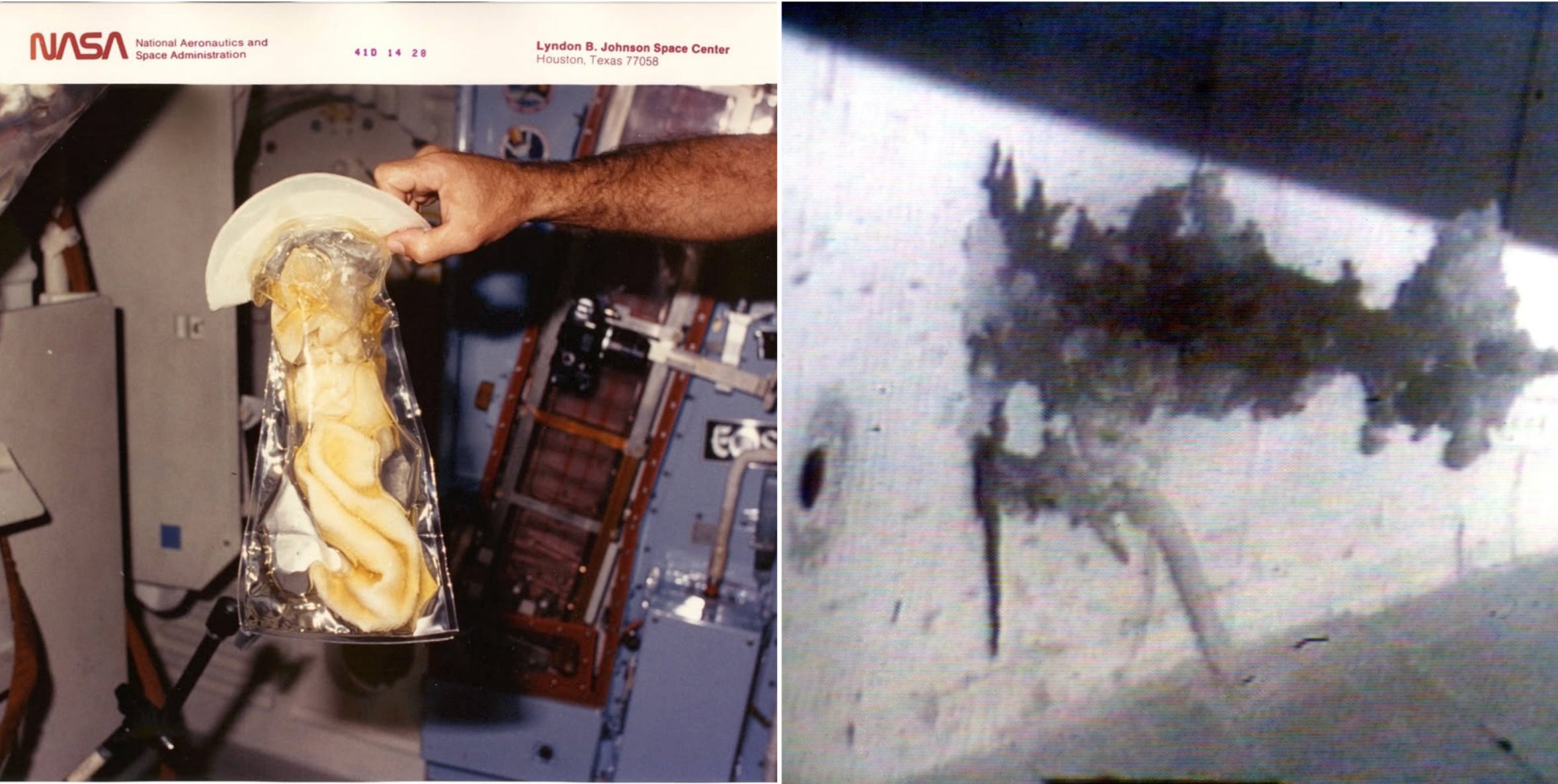
The Shuttle stored urine in storage in tanks that were periodically vented through space through a heated port in the hull. But On STS-41-D, a malfunctioning heater caused the material to freeze, creating a large yellow urinecicle outside the spacecraft. Astronaut Mike Mullane describes the aftermath:
[Mission control] called us. The heater on the outside of the dump nozzle failed, so this blob of frozen urine froze on the side of the vehicle, and what they were worried about was on reentry this blob of ice would break off, fly back, hit the tail, gouge out the heat tile. The tail would be burned off, and the Shuttle would crash: I thought of my life being threatened in many ways, but never by a block of frozen urine. Any rate, so we ended up using the robot arm. Hank used the robot arm to knock this piece of frozen urine off, but we were prohibited from using the urinal from that point, because they didn’t have any way of dumping it after that.
The crew spent the remainder of the mission peeing into sock-filled plastic bags, which they documented for posterity, along with the urinecicle itself:
The Shuttle toilet worked well on short missions, but sometimes ran into trouble with a full complement of crew. On one such flight, the overwhelmed toilet reversed flow and filled the cabin with a cloud of tiny freeze-dried fecal particles. It took several redesigns over the course of the program to finally solve the capacity problem, at which point it was time to pass the torch to the next generation of toilets on the International Space Station.
Since supplies flown to the station from Earth cost more than their weight in gold, there was early pressure on the ISS program to recycle water. The first Urine Processing Assembly, flown up in 2008, clogged up because dissolving bones gave astronaut urine a higher calcium content than the design anticipated. A modified UPA was later joined by a Brine Processing Assembly that could further desiccate processed urine. Together with a dehumidifier, these devices now recover about 98% of the water on the American half of the space station.
But for all that the urine system has advanced, fecal collection remains stuck in the Skylab era. Astronauts do their business in a one-time bag, seal their deposits (together with wipes, tissues, and gloves) inside, and then place everything in a hard-walled cylinder that eventually gets stuffed into a departing Dragon or Soyuz.
NASA has not been squeamish about gathering data to analyze every aspect of the space toilet. Used cylinders have been flown down from the space station and forensically disassembled, cataloguing each glove and wet wipe. NASA’s attitude to astronaut reports is best described as ‘trust but verify’.
Over the years, they’ve learned some things. NASA reports that a typical crewmember urinates six times a day, a number that seemed impossible until I started writing this essay and became hyperaware of bathroom visits. And a burst urine bag in the Skylab ground simulator taught the agency that ‘elimination events’ can vary in volume by a factor or three or more from the average. Peeing is not Gaussian.
The agency has also found that healthy people have pronounced variation in defecation—some need to go twice a week, while others go multiple times per day—and that cleaning up in space uses many more wipes and tissues than the same process on Earth, and requires a mirror.
All of this effort and toil has led to a space station toilet that, if not as beloved as a Japanese shower toilet, is at least tolerated by the crew.
Mars
Going to Mars takes space toilet challenges to the next level. The biggest of these is reliability: a space toilet is a complex device prone to breakdowns, and going to Mars would be the first NASA mission where a broken toilet could kill the crew.
Mars will need two very different toilet systems, one for the surface stay and one for the trip over. So it probably makes sense to talk about the two separately.
You may remember that the likely shape for a Mars mission is a six month journey out, followed by a 700 day surface stay, then a six month return trip to Earth. For radiation reasons, the crew probably has to spend all their time at Mars on the surface—you can’t leave one or two astronauts in orbit to tend the spacecraft.
The transit portions of this mission will resemble a stay on the International Space Station, which puts us within our experience base. But the 700 day gap, when the spacecraft has to wait in orbit with no humans on board, is a problem.
Both the water and sanitation systems on the space station are designed to be used frequently, and the regular flow of water through their parts helps to control microbial growth and flush away biofilms.
Once water sits stagnant inside a system for long periods of time, the fight against microbes gets challenging. NASA learned this lesson the hard way on the space station, when a drinking water assembly that waited too long on the ground arrived so contaminated with bacteria that it had to be thrown away. That system had been filled with sterile water, so you can imagine how much worse things get if you’re trying to stabilize a fecal tube or urine tank.
The Mars literature calls the problem of leaving habitable spacecraft unattended ‘quiescence’. You can think of it as the space version of getting a camper van or vacation home prepped for winter. There are multiple strategies that might work (filling the water and toilet systems with biocide, cooling the spacecraft to below freezing, draining and drying the system completely). But none has ever been tried, and it’s going to take some serious testing before we feel comfortable risking the life of a crew.
I’ve complained before that the runup to Mars would require long, boring human experiments in space. Designing for quiescence takes this problem to the next level. We need to build a space station, leave it empty for two years, then demonstrate that the toilet is not filled with cosmic horrors, and that all the life support systems can function for the six months it takes the crew to get back to Earth.
The other half of the Mars toilet puzzle is the surface stay. At 0.38g, Mars has the maximally inconvenient amount of gravity. On a log scale1, it sits right between zero-G and what we experience on Earth, with uncertain implications for toilet design. One thing we’ve learned from five decades of building space commodes is that there’s no substitute for actual flight experience. So it’s hard to see how we avoid building a rotating space station to test Martian plumbing in artificial gravity, along with other critical partial-gravity systems like dust filtration and smoke detectors.
Another design challenge for the surface is storage. If you include the mass of containers, four astronauts on a 700 day mission will leave behind three to four tons of highly septic waste. At least at first, this waste will give off gases that have to be vented to the atmosphere without allowing microbes to escape. And while this waste is bulky, you can’t just chuck it outside the airlock without making provisions to prevent it from contaminating the surface.
NASA has set itself the design goal of keeping astronaut waste sequestered for fifty years, and is in the early stages of testing vents and filters that can equalize pressure without getting rapidly clogged by dust. But this goal seems a little wild to me. NASA has trouble building structures that can last 50 years on Earth, let alone getting a level-4 biohazard storage shed on Mars right on the first try.
So a more workable approach might be to sterilize waste from the get-go. One promising approach is called torrefaction. It’s a kind of low-temperature roasting process that heats fecal bags to 200-250°C, hot enough to convert them to odorless char and recover some water while avoiding the problems (tar and noxious gases) that come with higher-temperature incineration. One potential design would combine fecal roasting with a trash compactor to create inert plastic tiles of processed waste that could be used as radiation shielding in the walls of the habitat.
Such are the glories of going to Mars!
Further Reading
If you like quantifiable data, you are going to love the Body Waste Management NASA STD-3001 Technical Brief (2022)
An enjoyable recent space toilet history from the Russian perspective: Overview of the Space Toilet History (2025)
A very readable NASA technical brief on torrefaction: Torrefaction Processing for Human Solid Waste Management (2016)
This paper on the toilet used in Artemis and the ISS goes into some of the details of what makes engineering the device so challening: NASA Exploration Toilet Hardware Technical Challenges and Accomplishments (2025)
I’m so sorry.
I have no problem using a space toilet as long as it's not designed by Howard Wolowitz!