Musk on Mars
A timeline of Musk's pronouncements about Mars exploration and settlement

This post is a chronology of Musk’s public timelines for landing on Mars, with some major SpaceX milestones interspersed for context.
I originally started compiling these statements in 2021 to maintain my sanity in the face of SpaceX enthusiasts debating about realistic timelines for Mars1, but figured the list might be of general interest to readers of this Substack. I’ve made it free to read for everyone.
I follow the timeline with some comments about Musk’s astonishing February 2026 pivot from settling Mars to building cities on the Moon.
2002
Musk’s public involvement with Mars begins with Mars Oasis, a piece of planetary performance art whose goal is to land a tiny greenhouse on Mars and photograph seeds as they germinate and begin to grow, a stunning image that Musk hopes will rekindle public interest in the space program.
Not having a rocket company at the time, Musk approaches the Russians for a pair of launch vehicles (repurposed ICBMs) to send this payload to Mars, but in the course of negotiations realizes that the real obstacle to space travel is prohibitive launch costs. He founds SpaceX to address the problem.
2005
At SpaceVision2005, Musk makes an early public mention of plans for the BFR2, a rocket design capable of launching 100 tons to low Earth orbit that will later evolve into Starship.
2008
SpaceX successfully launches Falcon 1, the first privately developed rocket to reach Earth orbit.
2009
In an interview at the Churchill Club, Musk says he will try to put an astronaut on Mars by 2020 or 2025.
2010
First orbital flight of SpaceX’s Falcon 9 rocket, which will become the most successful launch vehicle in history.
2011
Musk discusses a self-sustaining Mars base in an interview with Wall Street Journal’s Alan Murray. He anticipates putting a human on Mars in ten years [2021] in the best case, or 15-20 years [2026-31] in the worst case.
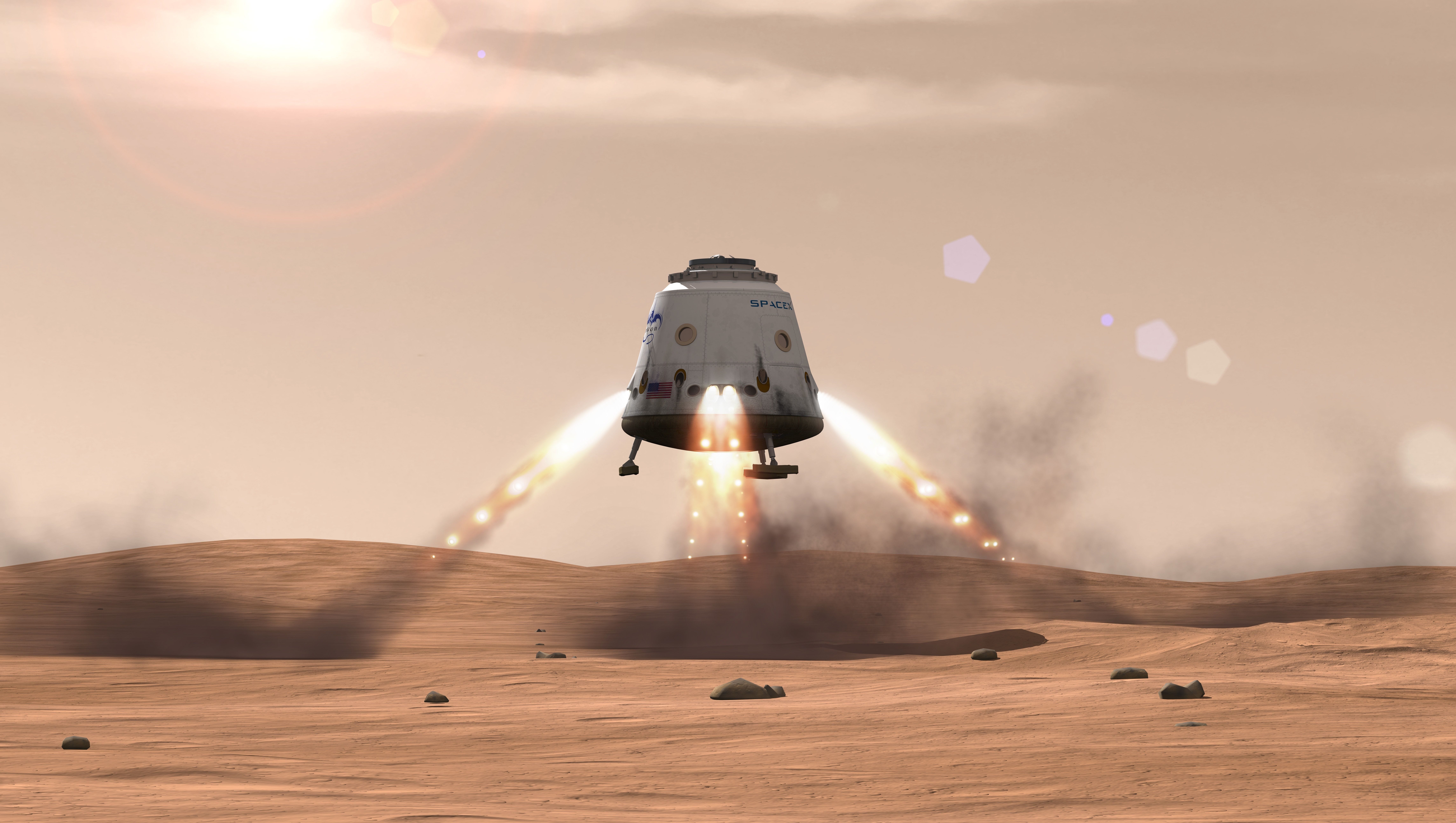
October: SpaceX and NASA publish a feasibility study on a concept called Red Dragon. In this mission design, a modified version of the Dragon capsule would launch on a Falcon Heavy booster and perform a retropropulsive soft landing on Mars before drilling underground for water.
2012
October: Musk makes the first mention of a large new SpaceX design called the MCT (later revealed to stand for Mars Colonial Transporter), a rocket previously known as the BFR.
Asked about a Mars landing in an interview on Nightline, Musk says “I'm confident at this point that it can be done. I think we'll be able to send, probably, the first people to Mars in roughly 12 to 15 years [2024-2027]. That's my estimate.”
2013
In an interview with Khan Academy, Musk says his best guess for a round-trip human mission to Mars is 2025.
2014
At the 2014 IEEE Aerospace conference, NASA presents an updated version of Red Dragon, this time envisioned as a sample return mission to launch in 2022.
2015
Musk tells blogger Tim Urban that SpaceX plans to “send an automated spaceship to Mars just to make sure you can send something there and back” by 2020.
December: First successful return and landing of a Falcon 9 booster stage after launch. This is an important proof of concept for reusable rockets, and a spectacular technical achievement by SpaceX.
2016
Starting in 2016, Musk and SpaceX begin making regular promises to launch an unmanned vehicle on Mars in the next synodic period, to be followed by human passengers two or four years later.
April: In a Facebook post and a tweet, SpaceX announces it plans to launch its first mission to Mars as soon as May 2018. After that “Red Dragon” flight, Musk says SpaceX’s goal will be to send at least one spacecraft to Mars during every interplanetary launch opportunity, which come every 26 months.
June: In an interview at the Code Conference, Musk says “we should be able to launch people [to Mars] probably in 2024 with arrival in 2025. […] That’s the game plan, in 2024, to launch the first of the Mars Colonial Transport system with people. This will be a very big rocket.”
September: In an interview with Sam Altman (then at YCombinator) Musk says a Mars landing “is potentially something that can be accomplished in about ten years [2026], maybe sooner. Maybe 9 years [2025].” He cites keeping SpaceX solvent as a key challenge to his Mars plans.
September: In a major presentation at the International Astronautical Congress in Guadalajara, Musk rolls out the “Interplanetary Transport System”. Musk makes it clear that his goal will be to launch at every Mars transfer opportunity, beginning with Red Dragon in 2018, and transitioning to the Mars Colonial Transporter whenever that becomes operational. He estimates that it will take 20-50 Mars launch windows (50-110 years) from the initial landing to get to a Martian population of 1,000,000.
2017
February: SpaceX announces that Red Dragon will slip from the planned 2018 launch date to 2020.
SpaceX signs up Yusaku Maezawa for a trip around the Moon in a Dragon space capsule, to be launched in 2018 on a Falcon Heavy booster.
June: In an interview with the Washington Post, Musk stresses his intent to launch rockets to Mars at every opportunity beginning in 2020. “Essentially what we’re saying is we’re establishing a cargo route to Mars… It’s a regular cargo route. You can count on it. It’s going happen every 26 months. Like a train leaving the station. And if scientists around the world know that they can count on that, and it’s going to be inexpensive, relatively speaking compared to anything in the past, then they will plan accordingly and come up with a lot of great experiments.”
July: Musk publicly abandons the Red Dragon concept in favor of the larger rocket laid out in his IAC talk the previous year.
September: Speaking at the IAC congress in Adelaide, Musk presents an updated vision of his 2016 plan. An unmanned landing by cargo ships will depart for Mars in 2022, followed by the first human astronauts in 2024.
2018
Musk publishes a paper in New Space titled “Making life interplanetary”. The paper, an edited transcript of his IAC talk, lays out an architecture for reaching Mars with a large reusable rocket (again called the BFR) capable of launching 150 tons to low Earth orbit. The cornerstones of the architecture are reusability, frequent launch cadence, orbital refueling, and fuel factories on Mars.
Musk predicts the first cargo landing on Mars will take place in the 2022 launch window, followed by two cargo and two crew landings in the 2024 synodic period.
At this stage, the shape of the return journey is nebulous. The first arrivals on Mars will also become settlers, working on a pilot plant for creating rocket fuel from local resources that would enable their eventual return to Earth (if they choose to go back).
Musk’s vision is of an initial landing site accruing Starships and crew members with each launch window, eventually expanding to become the nucleus of the first Martian city.
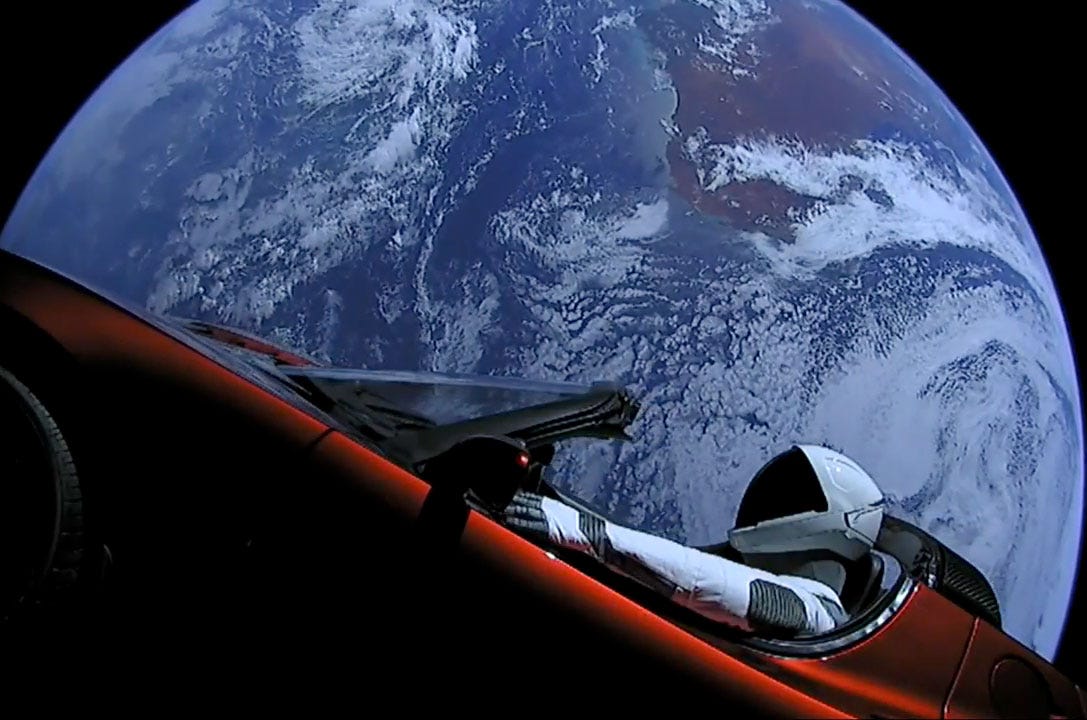
February: Musk puts his personal Tesla roadster on the maiden flight of the Falcon Heavy booster, sending it out towards the orbit of Mars.
September: plans for the dearMoon circumlunar mission with Maezawa are updated. Instead of launching aboard a Dragon capsule on Falcon Heavy in 2018, Maezawa and a group of guests will fly in 2023 on a human-rated version of Starship. Maezawa is reported to be fronting a ‘meaningful’ portion of the Starship development cost.
2019
September: Musk says Starship, which has yet to fly, “could be sending people to orbit within a year [2020].”
2020
May: The launch of Crew Dragon Demo-2 sends a pair of NASA astronauts to the International Space Station on a Falcon rocket. It is the first manned flight by SpaceX, the first manned flight on an American rocket since the Space Shuttle, and the first orbital flight by a commercial provider.
December: In an interview with Mathias Döpfner, CEO of Axel Springer, Musk says he's ‘highly confident' SpaceX will send humans to Mars in 2026, and possibly as early as 2024 “if we get lucky.” Musk adds: “And then we want to try to send an uncrewed vehicle there in two years [2022].”
2021
April: NASA enlists SpaceX to develop the Human Landing System, a derivative of its Starship second stage that will serve as a lunar lander for the agency’s Artemis project.
September: SpaceX launches future NASA Administrator Jared Isaacman and a crew of three on Inspiration4, the first private orbital spaceflight.
December: Asked on the Lex Fridman podcast when SpaceX will land a human being on Mars, Musk takes a long moment to think and replies, “best case is about five years [2026], worst case ten years [2031].”
2023
April: First flight test of Starship.
October: Speaking by videoconference at the IAC congress in Azerbaijan, Musk says he anticipates an unmanned test landing on Mars within the next four years [2027].
2024
June: Maezawa cancels the dearMoon circumlunar Starship flight, citing lack of a clear near-term schedule.
September: Musk tweets “The first Starships to Mars will launch in 2 years when the next Earth-Mars transfer window opens. These will be uncrewed to test the reliability of landing intact on Mars. If those landings go well, then the first crewed flights to Mars will be in 4 years. Flight rate will grow exponentially from there, with the goal of building a self-sustaining city in about 20 years. Being multiplanetary will vastly increase the probable lifespan of consciousness, as we will no longer have all our eggs, literally and metabolically, on one planet.”
2025
January: First flight test of Starship, version 2.
Responding to conjecture that the Moon might serve as a source of propellant for SpaceX’s Mars missions, Musk tweets “No, we’re going straight to Mars. The Moon is a distraction”.
March: Musk tweets “Starship departs for Mars at the end of next year, carrying [humanoid robot] Optimus. If those landings go well, then human landings may start as soon as 2029, although 2031 is more likely."
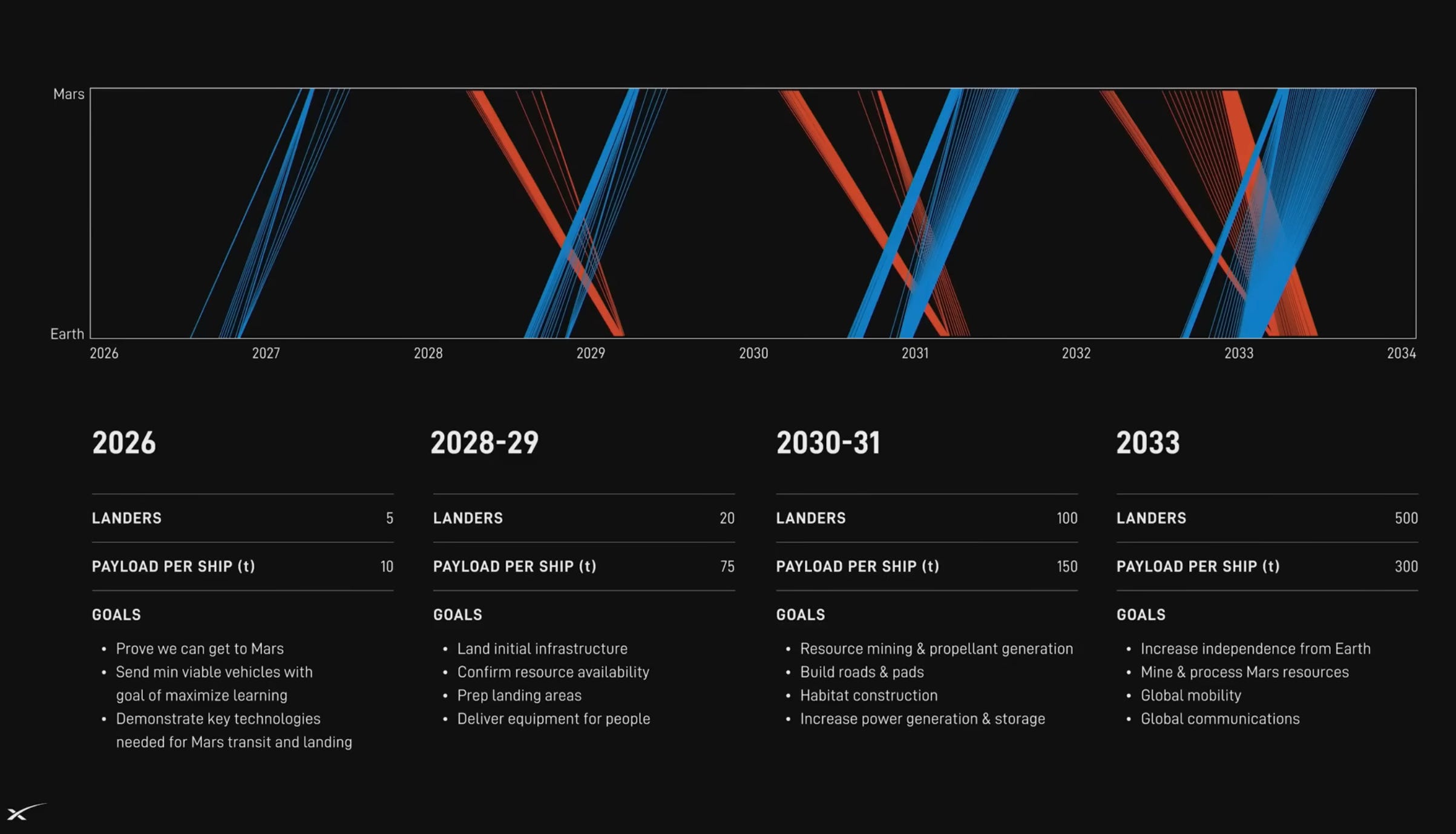
May: Musk gives an update on the progress of Starship at Starbase. The plan is now to send five Starships to attempt a Mars landing in the 2026 launch window. The first Starships will land an Optimus robot, with human landings to follow in either 2028/9, or more likely the 2031 window. Musk says he plans to land five Starships on Mars in 2026, 20 in 2028/9, 100 in 2031, and 500 in 2033.
December: Bloomberg reports that SpaceX is planning to go public in 2026, at a valuation of $1.75T.
2026
February: SpaceX acquires xAI.
Musk tweets “For those unaware, SpaceX has already shifted focus to building a self-growing city on the Moon, as we can potentially achieve that in less than 10 years, whereas Mars would take 20+ years.
The mission of SpaceX remains the same: extend consciousness and life as we know it to the stars.
It is only possible to travel to Mars when the planets align every 26 months (six month trip time), whereas we can launch to the Moon every 10 days (2 day trip time). This means we can iterate much faster to complete a Moon city than a Mars city.
That said, SpaceX will also strive to build a Mars city and begin doing so in about 5 to 7 years [2031-33], but the overriding priority is securing the future of civilization and the Moon is faster.”
Responding to pushback about his change of focus, Musk clarifies: “We’re still going to Mars and the timeframe for building a self-growing city there is still about the same at 20 to 30 years. [2056-2066]”
He later tweets: “To be clear, we are still going to do Mars. I don’t think this change affects the time to a Mars city being self-growing by more than 5 years and it might turn out to accelerate Mars.”
Remarks
Several patterns emerge in Musk’s Martian promises, besides the obvious one of a Mars landing always receding over the horizon.
One pattern is a reliance on spectacle to motivate and generate excitement. The Mars Oasis project is an early example, but others follow: stacking Starship for public display two years before it is ready to fly, the iconic photograph of a spacesuited astronaut passing Earth in a Tesla, or the lavish SpaceX renderings and movies that serve as a backdrop to Musk’s major public announcements about Mars.
Another pattern is Musk’s irrepressible desire to go big. The modest Red Dragon (which Musk could launch with his own money tomorrow, if he wanted to) gives way to Starship v1, which then gives way to Starship v2, v3, and now v4. By the time a previously promised rocket is ready to perform, Musk has typically lost interest and moved on to bigger plans.
A third, unexpected pattern is Musk’s steadfastness. Despite his aspirational mendacity in talking about timelines, until this year his vision for settlement remained rock steady. Mars was the backup planet we needed to colonize to preserve ‘the light of human consciousness’, and it was important to create a sufficient industrial base there for a colony to be self-supporting (and capable of developing interplanetary travel) even if they lost contact with Earth.
Just as consistent was his technical roadmap. Since at least the 2016 presentation to the IAC, Musk had stressed that SpaceX needed to develop four technologies (cheap launch, rapid reusability, orbital refueling, and fuel production from atmosphere and ice) to get to Mars. The company seemed well on its way to developing the first two capabilities, and was committed to inventing the third by its HLS contact with NASA.
Musk was also always clear that the purpose of SpaceX’s commercial arm was to subsidize his Mars plans. While cheap launches on Starship would revolutionize access to space, colonizing Mars was a grand civilizational project, not a money-making effort. For that reason, SpaceX could not become a public company before reaching Mars, because there would be no way to justify the Mars project to shareholders or a board of directors on financial grounds.
This unusual steadiness is what makes Musk’s pivot to the Moon last month so astonishing. By merging SpaceX with a company journalist Mike Isaac calls “a conveyor belt that carts cash into a furnace”, Musk has made it impossible for SpaceX to carry out his founding vision. Whatever the prospects for AI in the long term, it will have an infinite appetite for capital in the near term, and the commercial side of SpaceX cannot earn enough to fuel two money bonfires at the same time.
The structural changes Musk is making to his space company are permanent. Even if Musk later changes his mind about Mars, SpaceX is now welded to an enterprise that can immolate arbitrary quantities of money, as well as to an IPO that (by Musk’s own earlier logic) will preclude them from carrying out the founder’s great vision.
For true believers, this is a bitter moment. Whatever your private multiplier for Musk’s timelines, his willingness to spend vast money on Starship, and the astonishing technical progress of that program, served as a kind of proof of earnestness for his Mars plans. Even if you weren’t on board with the colony, the prospect of cheap Starship cargo flights to Mars created dizzying prospects for exploration.
Musk’s obsession also created a reality distortion field that made it difficult to discuss alternatives. As long as SpaceX was promising landings in two years’ time, it made little sense to advocate for a Mars mission by NASA (who can’t get even get back to the Moon), or to push for robots to be sent on rockets that would be made obsolete by Starship the first time it managed to refuel its tanks in orbit.
The rugpull must hit particularly hard for engineers at SpaceX who devoted their professional lives to realizing a vision that turned out to be a chimera. Like their predecessors at Tesla, they’ve learned that Musk can be fickle, and even years of highly public commitments to a transcendent vision are no guarantee of his future interest.
Further Reading
Scott Manley has a nice video about the Mars Oasis project.
For a 2015 snapshot of Elon Musk’s thinking about Mars colonization, see this long but informative series by Tim Urban.
For an independent evaluation of Musk’s Mars architecture, see About feasibility of SpaceX’s human exploration Mars mission scenario with Starship [2024]
I’ve argued previously that a mission to Mars would cost around half a trillion dollars, and could not take place before 2050.
‘Big Fucking Rocket’