
Artificial Gravity

There comes a point in reading about the health challenges of microgravity where you throw your hands up and cry, “just spin the spacecraft!”
Okay!
But as ever in space flight, when someone says “just do X”, there’s been 40 years of applied research into X, and taverns up and down the Space Coast are filled with grizzled engineers who devoted their careers to X and are drinking to forget. So let’s talk about why no one in sixty years has ever built a spaceship you can tap-dance in.
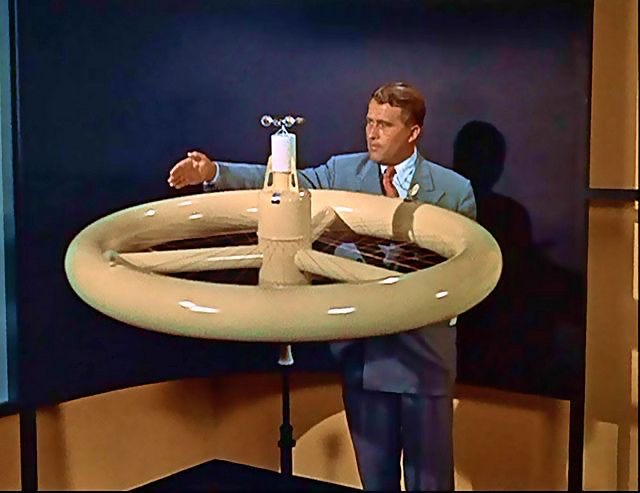
Research in artificial gravity has followed a kind of bathtub curve. At the start of the Space Age, everyone assumed that humans would need gravity to do any serious work in space, and there was a lot of foundational work around the minimum requirements for a rotating space home. Then, in 1973, Skylab showed that crews could spend multiple months in free-fall, get things done, and return to Earth without apparent harm. And so interest in artificial gravity waned. For a while, it looked like humanity might get away with exploring the entire solar system with just our socks on.
But over the ensuing decades, we learned that prolonged stays in zero-g do have health effects, and that these are both pernicious and intractable. So artificial gravity is back, baby! And because orbital mechanics forces missions to Mars to last multiple years, they are the obvious candidate for trying it out.
Basic Principles
The idea behind artificial gravity is simple. If you spin a large structure in space fast enough, anyone standing on its edge will feel a force in the outward direction. If the structure is big, and rotates slowly, that force will be hard to distinguish from the kind of gravity we have at home, and the crew can go jogging on the coolest track in the Solar System.
How much force you feel on the rim of a rotating habitat depends on both the spin rate and radius. At one revolution per minute, a structure needs to be nearly two kilometers long to create 1g. At ten revolutions per minute, you only need a structure 18 meters long, about the length of a semi truck. So it is important to know how much spin we can get away with.
As with many aspects of human space flight, it all comes down to barfing.
Keep reading with a 7-day free trial
Subscribe to Mars For The Rest of Us to keep reading this post and get 7 days of free access to the full post archives.